
Faster Finishing. Less Grit. Made in the USA.
The Thumler’s UV-10 Industrial Vibratory Tumbler is a heavy-duty vibratory finishing machine designed for hobbyists, lapidary enthusiasts, collectors, and professionals who want faster results and more efficient use of tumbling media.
With its 10-pound capacity bowl, powerful 1/30 HP motor, and 3,000 vibrations per minute, the UV-10 creates a vigorous cyclonic tumbling action that continuously moves the material around the bowl and toward the raised center. This makes it particularly effective for smoothing and polishing rocks after the initial shaping stage, while also making it an excellent machine for polishing brass cases and finishing other materials.
Unlike a rotary tumbler, which relies on rocks cascading and falling over one another, a vibratory tumbler uses rapid vibration to move the material through the abrasive. The result is significantly faster processing with much less grit and polish consumption.
Proudly made in the USA.
Why Choose the Thumler’s UV-10?
The UV-10 is an excellent choice when you want to process more material in less time without continually purchasing large quantities of abrasive.
Key Benefits
- 10-pound material capacity
- 3-quart removable polyethylene bowl
- 3,000 VPM vibratory action
- 1/30 HP motor
- 115V operation
- Thermally/overload protected motor
- Ball-bearing motor
- Heavy-duty industrial design
- Removable bowl and lid for easy loading and cleaning
- Made in the USA
- Excellent for rocks, stones, brass, and other finishing applications
- Uses substantially less grit and polish than a comparable rotary tumbler
- Vibratory action produces results much faster than traditional rotary tumbling
Thumler’s lists the UV-10 as a 10-lb-capacity vibratory tumbler, while RockTumbler's operating guide specifically describes the Industrial UV-10 as the version designed for rock tumbling.
10-Pound Capacity
The UV-10 features a large 3-quart polyethylene bowl capable of processing approximately 10 pounds of material.
For rock tumbling, that 10-pound capacity includes the combined weight of your rough rock and any ceramic or other tumbling media being used.
The bowl should not simply be filled with rocks to the maximum possible level. Proper loading is critical to getting the smooth, controlled action that makes a vibratory tumbler so effective.
Powerful 3,000 VPM Vibratory Action
The UV-10 vibrates at approximately 3,000 vibrations per minute (VPM) using a 1/30 HP motor.
The motor's vibration causes the material inside the bowl to move in a continuous cyclonic pattern around the bowl and down toward the center. This creates thousands of points of contact between the rocks, media, and abrasive.
The result is an extremely efficient grinding and polishing action.
The UV-10's vibratory process is particularly useful for the later stages of rock tumbling because it can smooth and polish material considerably faster than a conventional rotary tumbler.
Vibratory vs. Rotary Tumbling
One of the biggest advantages of the UV-10 is speed.
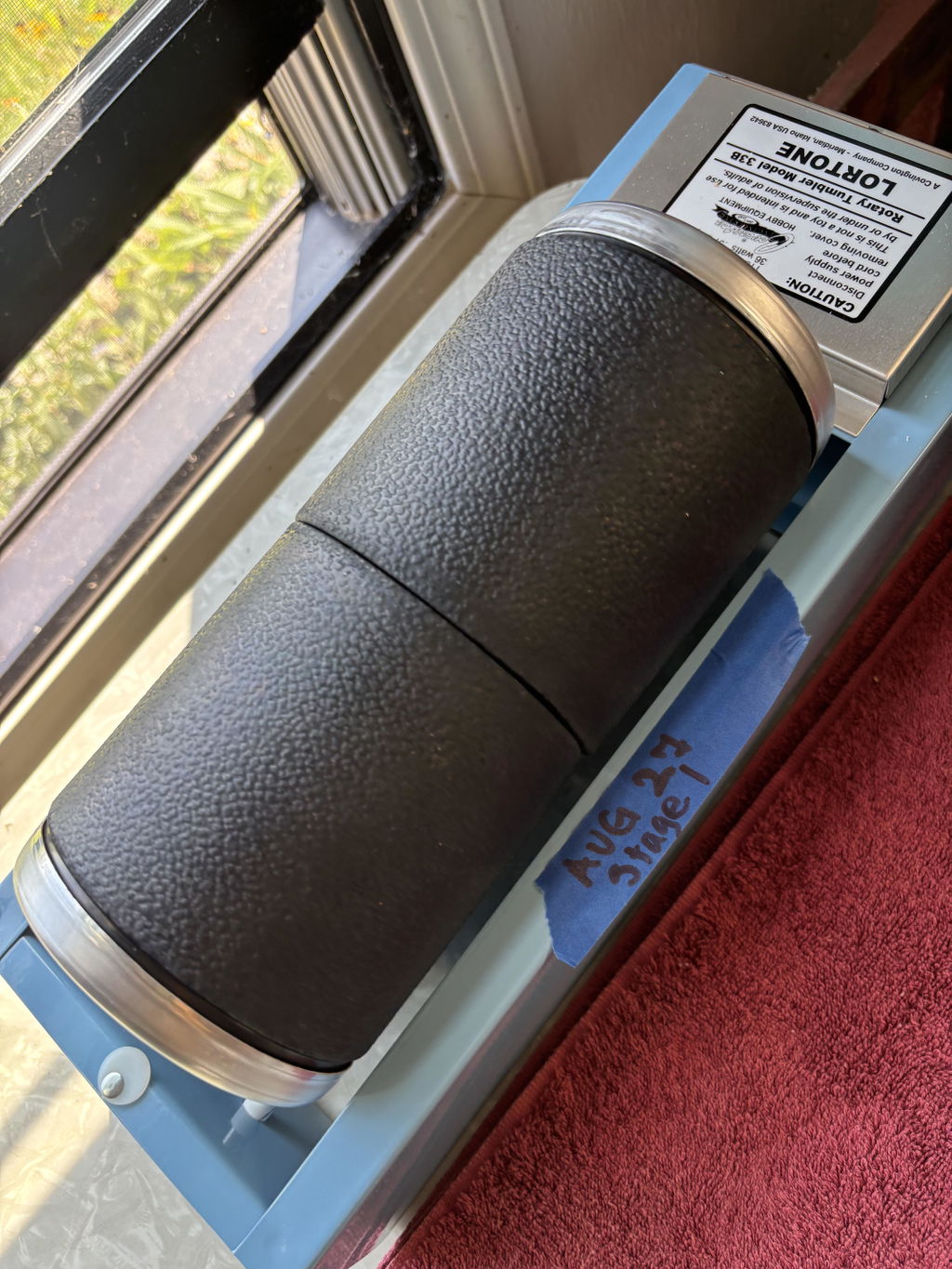
A traditional rotary tumbler relies on the rocks lifting up the side of the barrel and cascading back down. This action is excellent for rounding sharp edges and changing the overall shape of rough material, but it can require weeks to complete a full tumbling cycle.
A vibratory tumbler works differently.
The rapid vibration causes the material to move continuously against itself and the abrasive. This allows the abrasive to work much more efficiently.
The best of both worlds
For many serious rock tumblers, the best approach is to use both types of tumblers.
A rotary tumbler can be used for the coarse grinding stage to round and shape rough material. Once the stones have reached the desired shape, the UV-10 can be used for the medium, fine, and polishing stages.
This combination gives you the shaping benefits of rotary tumbling with the speed and efficiency of vibratory finishing.
Designed for Rock Tumbling
The Industrial UV-10 is the version recommended for rock tumbling.
This distinction is important because Thumler’s has produced both standard and industrial versions of the UV-10. The standard version was designed primarily for brass shell casings and is not intended to withstand the stresses associated with heavy rock loads. The Industrial UV-10 uses the heavier-duty configuration required for rock tumbling.
If you're purchasing a UV-10 specifically for rocks, gemstones, glass, or other heavy material, make sure you're purchasing the Industrial version.
Excellent for Larger Rough Material
The UV-10 has a significant advantage over many small rotary tumblers when working with larger pieces of rough.
The Industrial UV-10 can accommodate rocks measuring up to approximately 2 inches in one dimension, with the other dimension generally kept to about 3 inches or less. Larger pieces should be limited in number and surrounded by smaller material and/or ceramic media to maintain proper movement.
This makes the UV-10 particularly useful for larger agates, jaspers, petrified wood, quartz, and other durable materials.
However, particle-size balance is extremely important. A bowl containing only large pieces can become noisy and may cause the rocks to bruise against one another. Mixing larger rocks with smaller material or ceramic media creates more contact points and cushions the larger pieces.
Use Ceramic Media for Better Tumbling Action
Ceramic media can be extremely useful in a vibratory tumbler.
We recommend using ceramic cylinders or other appropriate media when you need additional cushioning, more particle-size variety, or better movement through the bowl.
We recommend using at least 20% ceramic media in the UV-10 for many rock-tumbling applications. When working with large pieces or more delicate materials such as obsidian or glass, they recommend increasing the amount of ceramic media as needed.
Ceramic media can:
- Improve the movement of material through the bowl
- Fill empty spaces between larger rocks
- Cushion stones and reduce bruising
- Help carry abrasive into irregular areas
- Reduce noise
- Improve overall tumbling action
Uses Much Less Grit Than a Rotary Tumbler
One of the biggest advantages of vibratory tumbling is abrasive efficiency.
Because the material is constantly moving against the abrasive, the UV-10 requires considerably less grit and polish than a comparable rotary tumbler.
Do Not Use Coarse Grit in the UV-10
The UV-10 is not normally used with coarse silicon carbide grit.
For the first vibratory grinding stage, we recommend medium grit in approximately the 150/220 mesh range rather than coarse grit.
Coarse grit particles are too large to adhere effectively to the rocks and media during vibratory operation. They can settle to the bottom of the bowl and can also accelerate wear on the polyethylene bowl.
If you are starting with very rough, angular material that requires significant shaping, a rotary tumbler is often the better choice for the initial coarse-grinding stage.
A Complete Vibratory Rock Tumbling Process
The UV-10 can be used for the later stages of a complete rock-tumbling process.
Stage 2 – Medium Grinding
After the rough rocks have been shaped, use approximately 150/220 medium silicon carbide grit in the UV-10.
The medium grit continues smoothing the stones and removing scratches and surface irregularities.
A typical run is approximately two to three days, although harder materials or stones requiring additional shaping may require additional runs.
Stage 3 – Fine Grinding
Once the stones are thoroughly cleaned, move to a finer abrasive such as 500-mesh silicon carbide.
This stage further removes the scratches left by the previous grinding stage and prepares the stones for polishing.
Stage 4 – Pre-Polish / Fine Finish
Depending on the tumbling process and abrasive system being used, the fine-grinding stage can serve as the preparation stage before final polish.
Proper cleaning between stages is critical.
Stage 5 – Final Polish
The final stage uses a polishing compound such as aluminum oxide or another appropriate rock-polishing compound.
The goal is to produce a smooth, glossy surface while bringing out the natural color, patterns, translucency, and character of the stone.
RockTumbler reports excellent results using TXP aluminum oxide polish in the UV-10 on materials including agate, jasper, and petrified wood.
Water Control Is Critical
One of the most important differences between rotary and vibratory tumbling is the amount of water required.
With the UV-10, more water is not necessarily better.
The goal is to add just enough water to allow the abrasive to cling to the rocks and media while providing lubrication for the vibratory action.
If too much water is added, the grit can wash off the rocks and settle at the bottom of the bowl. If too little water is used, the slurry can become too thick and restrict the movement of the material.
As the tumbler runs, water will evaporate and rock particles will accumulate in the slurry. The bowl should therefore be checked regularly and small amounts of water added as necessary.
We recommend checking the UV-10 approximately two or three times per day while running a rock-tumbling cycle.
This is one reason the UV-10 is best suited to users who are willing to monitor their tumbler rather than simply turning it on and leaving it unattended for several days.
Removable Heavy-Duty Polyethylene Bowl
The UV-10 uses a removable polyethylene bowl with a lid.
The bowl can be removed from the machine for loading, unloading, cleaning, and changing abrasive stages.
The polyethylene construction provides a durable working surface for the abrasive and material being processed.
Replacement UV-10 bowls are also available, along with replacement lids, foam pads, bases, vibrator plates, center posts, motor components, and other parts. Thumler’s current parts catalog demonstrates that the UV-10 is designed to remain serviceable rather than being treated as a disposable machine.
Heavy-Duty Motor
The UV-10 uses a 1/30 HP ball-bearing motor operating on 115 volts.
The motor is overload protected and provides the vibration necessary to maintain the cyclonic movement of the material in the bowl.
The motor and counterweight system are specifically designed to generate the strong vibratory action required for this type of finishing.
Made for Long-Term Use
The UV-10 is built around a serviceable design rather than a sealed, disposable appliance.
Replacement components are available for the machine, including:
- Replacement bowl
- Bowl lid
- Bowl foam pad
- Base foam pad
- Vibrator plate
- Center threaded post
- Motor and counterweight
- Motor counterweight
- Motor mounting brackets
- Base
Thumler’s continues to offer these replacement components for the UV-10, making it possible to maintain and repair the machine over its service life.
Don't Overtighten the Bowl
The bowl and lid are held in place using the center post, washer, and wing nut.
The wing nut should be tightened only enough to securely hold the bowl and lid in position.
Over-tightening can deform or damage the bowl and may damage the threaded center post. The foam pads help hold the bowl securely during operation.
Keep the Bowl and Base Clean
Proper cleaning is particularly important when using a vibratory tumbler.
Old grit, dried rock mud, and polishing compound can contaminate the next stage and prevent the stones from achieving their best possible finish.
Clean the bowl, lid, foam pads, center post, and stones thoroughly between every abrasive stage.
Also inspect the base pad regularly. A piece of rock or abrasive trapped underneath the bowl can cause excessive wear as the machine vibrates.
Cleaning the UV-10 immediately after each stage helps prevent dried slurry from becoming difficult to remove and reduces the chance of cross-contamination between stages.
Excellent for Brass & Other Finishing Applications
Although the UV-10 is an excellent rock tumbler, vibratory tumblers are extremely versatile.
The UV-10 can also be used for:
- Brass cartridge case polishing
- Deburring
- Metal finishing
- Surface finishing
- Smoothing and polishing various materials
For brass polishing, appropriate dry media such as crushed walnut shell or corncob media can be used.
UV-10 Specifications
SpecificationDetails
- Model: Thumler’s UV-10 Industrial
- Type:Vibratory Tumbler
- Capacity: 10 lbs.
- Bowl Capacity: 3 quarts
- Bowl Material: Heavypolyethylene
- Bowl: Removable
- Motor:Ball-bearing
- Motor Power1/30 HP
- Voltage: 115V
- Vibration Speed: 3,000 VPM
- Motor Protection: Overload protected
- Machine Dimensions: 10" diameter × 11" high
- Bowl Exterior: Approximately 10" diameter × 4-1/4" high
- Lid: Approximately 8" diameter × 7/8" high with foam
- Country of Manufacture: USA
- Warranty: 1-year limited warranty
Specifications are based on current Thumler’s information and detailed UV-10 documentation from RockTumbler.
What Size Rocks Can You Tumble?
The UV-10 can handle a surprisingly wide range of rock sizes.
For larger pieces, RockTumbler recommends keeping one dimension under approximately 2-1/8 inches so the material can move properly around the raised center of the bowl. The other dimension should generally be no more than about 3 inches. Larger pieces should be used sparingly and surrounded by smaller material and/or ceramic media.
For best results, use a mixture of particle sizes rather than filling the bowl exclusively with similarly sized large rocks.
This helps maintain proper movement, cushions the stones, and reduces bruising.
What Rocks Work Well in the UV-10?
The UV-10 is especially well suited to harder materials such as:
- Agate
- Jasper
- Petrified wood
- Quartz
- Chalcedony
- Many types of chert and flint
- Durable metamorphic and igneous rocks
- Other materials appropriate for vibratory tumbling
Hardness, durability, shape, and internal fractures should always be considered before tumbling a particular material.
Soft or fragile materials may require specialized media, shorter runs, or a different tumbling method.
Important: Vibratory Tumbling Does Not Round Stones Like a Rotary Tumbler
If your goal is highly rounded, smooth stones, it is important to understand the difference between the two types of machines.
A rotary tumbler repeatedly lifts and drops the rocks, producing substantial contact and impact that gradually rounds the stones.
A vibratory tumbler moves the material rapidly without the same degree of cascading and dropping.
As a result, the UV-10 is excellent for smoothing and polishing while preserving more of the original shape of the stones.
For this reason, many experienced tumblers use a rotary tumbler for initial shaping and a vibratory tumbler for the later stages.
Thumler’s UV-10 vs. a Rotary Tumbler
If you're deciding between the UV-10 and a rotary tumbler, the biggest difference is how the machine moves the material.
Choose a rotary tumbler if you:
- Need to aggressively shape and round rough rock
- Want rounded, smooth stones
- Are starting with very angular material
- Prefer a simple set-it-and-check-it approach
Choose the UV-10 if you:
- Want much faster processing
- Want to use substantially less grit and polish
- Want to preserve more of the stone's original shape
- Frequently tumble and polish rocks
- Need to process larger quantities
- Want a versatile machine for rocks and other finishing applications
For serious rock tumbling, you don't necessarily have to choose one or the other. Using a rotary tumbler for shaping and the UV-10 for smoothing and polishing can give you the advantages of both processes.
Keep Tumbling More Efficiently
The Thumler’s UV-10 Industrial Vibratory Tumbler is a serious step up from small hobby tumblers. Its combination of 10-pound capacity, 3,000 VPM vibratory action, 1/30 HP motor, heavy-duty polyethylene bowl, efficient abrasive consumption, and USA-made construction makes it an excellent choice for anyone who wants to process and polish rocks faster.
If you regularly tumble rocks, the UV-10 can save significant time and reduce your ongoing grit and polish costs compared with relying exclusively on a rotary tumbler.
For shaping, smoothing, and polishing rocks with speed and efficiency, the Thumler’s UV-10 is one of the most capable vibratory tumblers in its class.